
WP2: Early exposure to social and chemical stressors –
Impact on respiratory health
| Teams
Duration: 3 years
Budget: €598,000
Scientific Coordinator:
Xavier Coumoul, HealthFex Unit, UMR-S1124, Paris
Partners:
Emmanuelle Bouzigon, Karine Audouze, Christel Becker, Emma Juillet, HealthFex Unit, UMR-S1124, Paris
Valérie Siroux, Aurélie Nakamura, Institute for Advanced Biosciences (IAB), UMR1209, Grenoble
Sophie Lanone, Sarah Ducellier, Mondor Institute for Biomedical Research (IMRB), UMR955, Créteil
| Context
Air pollution, whether from outdoor sources like traffic, agriculture, industry, or tobacco smoke, represents a major public health issue, causing millions of deaths each year. Individual vulnerability to pollutants varies and is influenced by genetic, epigenetic, and psychosocial factors. The exposome concept encompasses all non-genetic environmental exposures over a person’s lifetime, offering a framework for understanding how environmental stressors affect health. Among these stressors, perceived social stress can lead to serious health outcomes such as asthma, particularly in children exposed to maternal psychological stress during pregnancy. The complex interaction between perceived stress and pollution highlights the need to study their cumulative effects on health.
| Description
Work Package 2 (WP2) focuses on the impact of early-life exposure to two key stressors within the exposome on respiratory health, integrating both epidemiological and toxicological approaches. By examining both the social component (maternal social stress) and the chemical component (cigarette smoke), we hypothesize that these factors may interact synergistically, amplifying each other’s effects. This hypothesis suggests that the combined effects of psychological stress and pollution are not merely additive, but could create a vicious cycle that heightens risks for vulnerable populations. WP2 also brings together diverse technical expertise to study these interactions, enabling a deeper understanding of the underlying mechanisms.
| Objectives
The main objective of this project is to assess the interactions between maternal psychological stress and smoking during early life, and their consequences on children’s respiratory health. Given the association between early stress and depressive comorbidities, and the availability of relevant data in the ELFE cohort, WP2 will also investigate depressive and anxiety phenotypes in children as secondary outcomes. To address the complexity of the effects of these two factors, WP2 will employ both combined epidemiological approaches and animal models to identify physiological disruptions and underlying cellular mechanisms.
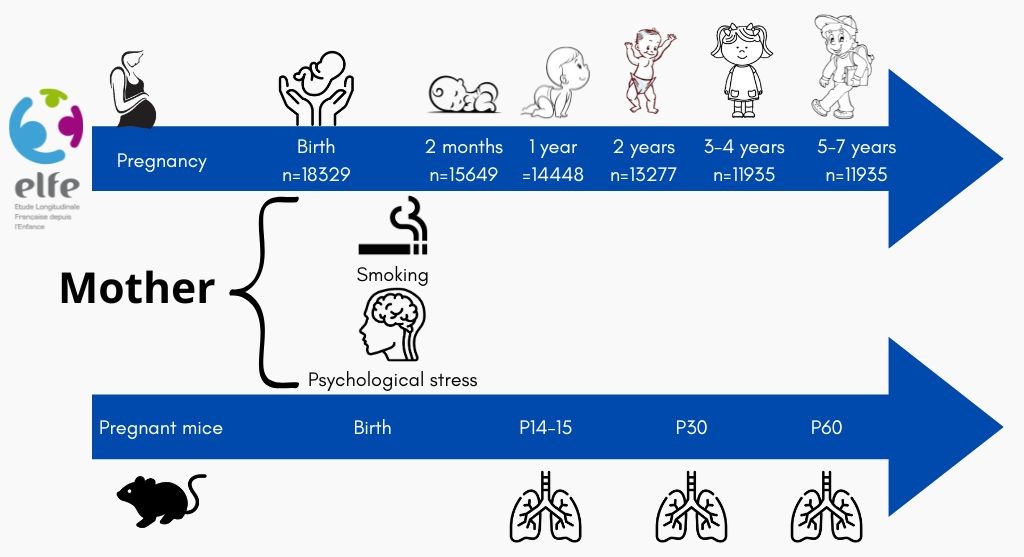
Adverse Outcome Pathways (AOPs) related to respiratory health will also be developed. These will serve as predictive tools in toxicology to anticipate health events in response to environmental stressors. The findings from this WP will underscore the importance of mitigating at least one of these stressors to protect the health of at-risk populations and guide public policy.
| WP2 includes 3 tasks
Task 1: Impact of Maternal Stress and Smoking on Child Respiratory Health
More information
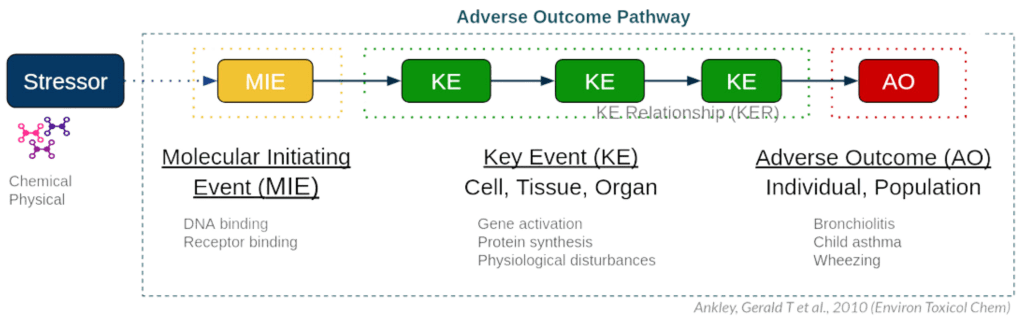
The general objective of this task, based on an epidemiological approach, is to better characterize and understand child well-being and development. Sub-tasks include:
- Assessing the associations between respiratory and allergic health outcomes in children up to the age of 5 to 7 years and maternal stress/anxiety as well as early-life exposure to tobacco smoke.
- Assessing the statistical interaction between maternal social stress and tobacco exposure on children’s respiratory health.
Task 2: Experimental Evaluation of Prenatal Exposome Effects on Respiratory and Anxiety Disorders
More information
The aim of this task is to experimentally evaluate how exposure to one or both components of the exposome (chemical, social) contributes to the development of respiratory disorders and anxiety-like behaviors following gestational tobacco exposure. As in the human study, the exposome components will include cigarette smoke and a life stressor.
Task 3: Development of AOPs Based on Exposure and Effect Biomarkers
More information
The overall objective of this task is to propose new AOPs based on the identification of exposure and effect biomarkers in Task 2 and their potential validation in Task 1.
 Programme d'impulsion Exposome