

WP1: Socio-territorial inequalities in exposure at the national level
| Teams
Duration: 3 years
Budget: €347,900
Scientific Coordinator:
Cyrille Delpierre, Centre for Epidemiology and Population Health Research (CERPOP), UMR1295, Toulouse
Partners:
Laurence Mabile, Lola Neufcourt, CERPOP, UMR1295, Toulouse
Julie Vallée, LISST, UMR5193, Toulouse
Marie-Aline Charles, Thierry Simeon, ELFE Cohort, UMS2, Aubervilliers
Marie Zins, Emeline Lequy-Flahault, Sofiane Kab, Emmanuel Wiernik, Nhu Tien Vu, CONSTANCES Cohort, UMS11, Paris
Gianluca Severi, Elodie Faure, Elodie Speyer, Thibaud de Filippis, E3N-Générations Cohort, UMR1018, Villejuif
Johanna Lepeule, Ariane Guilbert, IAB, U1209, Grenoble
Eloi Chazelas, ERES, UMRS1136, Paris
| Context
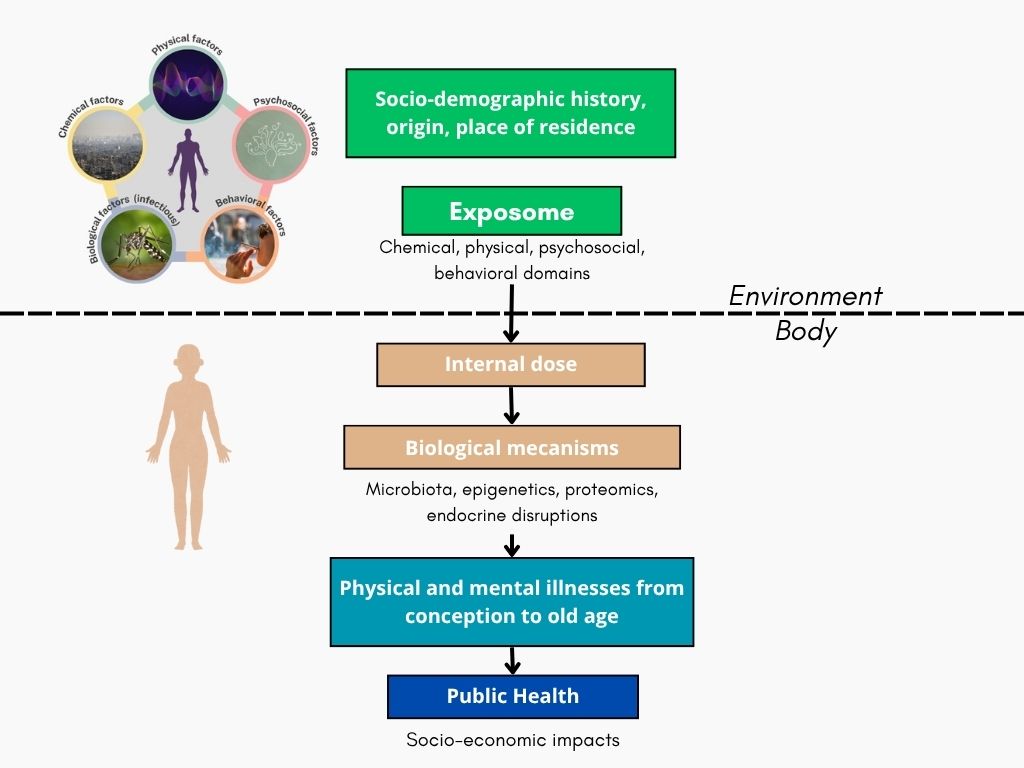
From birth and throughout their lives, humans are exposed to a wide range of environmental factors, including physical, chemical, biological, social, and psychosocial elements, all of which can affect health. Over the past two decades, the link between neighborhood or place of residence and health has become increasingly documented, highlighting how neighborhoods impact many dimensions of physical and mental health through chemical exposures (such as air pollution), physical exposures (such as walkability, access to green spaces and health/social services), and psychosocial exposures (such as social cohesion or violence).
In exposome research, the role of the social environment remains largely overlooked, although it should be considered central. The social environment may influence health through two main types of mechanisms:
- Exogenous mechanisms, involving external molecules, encompassing physico-chemical and behavioral exposures;
- Endogenous mechanisms, involving subjective interpretation and internal molecules, corresponding to psychosocial exposures.
| Description
Work Package 1 (WP1) focuses on socio-territorial inequalities in exposure, taking a national-level approach. It addresses the impact of the social environment, a factor often underexplored in exposome research. Social determinants of health—such as social position, sex, country of birth, and place of residence—influence various types of exposures (physico-chemical, behavioral, and psychosocial).
| Objectives
The overall objective of WP1 is to characterize the relationships between social determinants—such as social position (education level, profession/occupational category, income), sex, country of birth, and geographic location (place of residence)—and the exposome (physico-chemical, behavioral, and psychosocial exposures). In other words, it aims to evaluate social inequalities in these types of exposures.
The ultimate goal is to develop an integrated framework analyzing the links between socio-territorial factors and the exposome, considering its three main dimensions: physico-chemical, behavioral, and psychosocial.
| WP1 includes 2 tasks
Task 1: Inventory of social and environmental databases
More information
The goal of Task 1 is to compile an inventory and mapping of available social and environmental databases in France (mainland and overseas territories). This task will involve exploring the possibilities for cross-linking and integrating these databases and providing recommendations to enhance their future integration, with the ultimate aim of enabling linkage with health data.
Task 2: Characterizing socio-territorial inequalities in the exposome
More information
Task 2 aims to begin characterizing socio-territorial inequalities in the exposome using individual-level data. This involves analyzing how social position, sex, and geographic origin shape the human exposome in connection with place of residence, using cohort data.
 Programme d'impulsion Exposome